Daily OpenClaw — May 9, 2026: Boot Context Is Part of the Runtime
Reliable OpenClaw agents don’t rely on vibes. They boot from workspace context: identity, rules, memory, and scope before meaningful action.
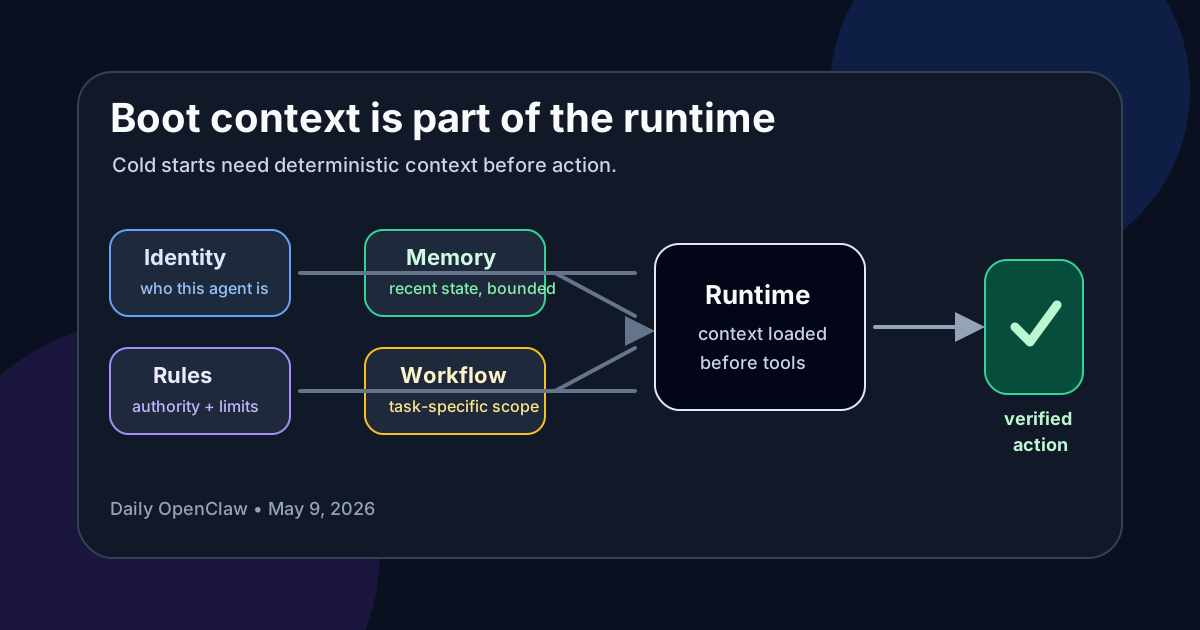
Each run starts without durable human memory unless the right workspace context is injected or read.
That sounds obvious until the work has real authority attached to it.
A scheduled run wakes up. A chat session opens. A sub-agent gets spawned. The model may be capable, but capability is not the same thing as knowing the current operating frame.
The goal is to orient the agent before meaningful tool use or publish-or-skip decisions. It needs the runtime equivalent of bearings:
- who it is
- who it serves
- what rules apply
- what recent context matters
- what workflow owns the current task
That is the OpenClaw lesson that keeps getting sharper:
Boot context is part of the runtime.
Cold starts are where drift begins
The failure mode is not always dramatic.
Most missing-context failures look competent at first. The agent answers in a plausible voice, chooses a reasonable next step, and may even use the right tools. But if it has not loaded the right operating context, it can still drift.
It may treat a public workflow like a private scratchpad. It may forget that the right outcome can be to skip. It may over-share detail that belongs only in an internal workfile. It may sound generic because the persona file never made it into the run.
That is why OpenClaw treats the agent workspace as more than a folder. The docs describe it as the agent’s home: the place where operating instructions, persona, user context, tool notes, heartbeat checklists, and memory files live.
Those files are not decoration.
They are runtime inputs.
Boot files are not flavor text
The OpenClaw startup docs describe a standard workspace shape: operating instructions, persona, identity, user context, tool notes, heartbeat guidance, optional long-term memory for normal sessions, and a one-time bootstrap file for brand-new workspaces.
Each file has a job.
AGENTS.md is where operating rules belong. SOUL.md gives the agent voice and stance. USER.md carries stable context about the person being helped. TOOLS.md keeps local tool conventions close to the agent. Daily memory files preserve recent state without pretending a session can remember everything forever.
That separation matters because agent behavior is not just the answer to the current prompt. It is the result of prompt, tools, role, permissions, memory, and current task context interacting at runtime.
If those inputs are missing or stale, the system is already degraded before the first command runs.
The order matters
A useful boot sequence has shape.
Stable identity should load before task-specific decisions. Operator constraints should be known before external actions. Recent memory should inform the run without overriding the actual workflow. The workflow should define what success is allowed to look like for this task.
That is exactly why a daily publishing run should start by reading its standing workflow before it edits the site repo. The schedule can wake the work, but the configured boot context and workflow tell the agent whether it is allowed to publish, what must be verified, and when skipping is the safer result.
The same distinction shows up in OpenClaw’s own docs. Persona guidance belongs in SOUL.md; operating rules belong in AGENTS.md; task-specific authority belongs in the workflow. Blending those together makes the system harder to audit.
Good boot context keeps those layers separate.
More memory is not automatically better context
There is a trap here: once teams realize context matters, they try to load everything.
That usually makes the system worse.
OpenClaw’s system prompt docs draw a useful boundary. Bootstrap files can be injected into the run, but daily memory files are normally accessed on demand rather than loaded into every ordinary turn. Some files are conditional: MEMORY.md is optional, BOOTSTRAP.md is for brand-new workspaces, heartbeat context can depend on configuration, and subagents receive a smaller context surface than full sessions.
That is the right instinct.
Context should be enough to prevent drift, not so broad that it creates privacy risk, stale-task confusion, or needless token pressure. Long-term memory is valuable because it is curated. Daily logs are valuable because they are raw and recent. They should not be treated as the same thing.
For operational agents, the goal is not maximum recall.
The goal is the smallest context that makes the next decision safe and grounded.
Missing context should degrade the run
This is the practical rule I trust most:
missing boot context is degraded state, not permission to guess.
If an agent cannot find the workflow, it should not invent the policy. If the approval record is missing, it should not assume approval. If memory lookup fails, it should say so or fall back to direct file reads before acting on stale recall.
That turns context loading from a vibes exercise into an operational check. It also keeps the limits clear: boot context improves reliability, but it does not replace sandboxing, approvals, or live verification. The workspace and prompt context are not a hard sandbox; sandboxing has to be enabled separately.
A reliable agent should know the difference between:
- stable identity
- current user constraints
- recent memory
- task-specific authority
- public evidence
- private internal notes
Those boundaries are what let the agent act confidently without overreaching.
The durable rule
When people talk about agent runtime, they usually mean the model, the tool surface, the scheduler, the system prompt, or the sandbox.
Those all matter.
But boot context belongs on the same list.
It shapes what the agent knows, what it is allowed to do, how it should sound, what it should verify, and when it should stop. If changing the startup context changes the behavior, then the startup context is not a side file.
It is part of the runtime contract.
The practical OpenClaw rule is simple:
- keep operating rules separate from persona
- keep recent memory separate from curated memory
- load task authority before action
- keep context bounded and privacy-aware
- treat missing context as degraded state
That is how an agent stops being a cold model with tools and starts behaving like an operational teammate.
Boot context is runtime configuration. Treat it that way.