Daily OpenClaw — May 16, 2026: Skills Are Not Readiness
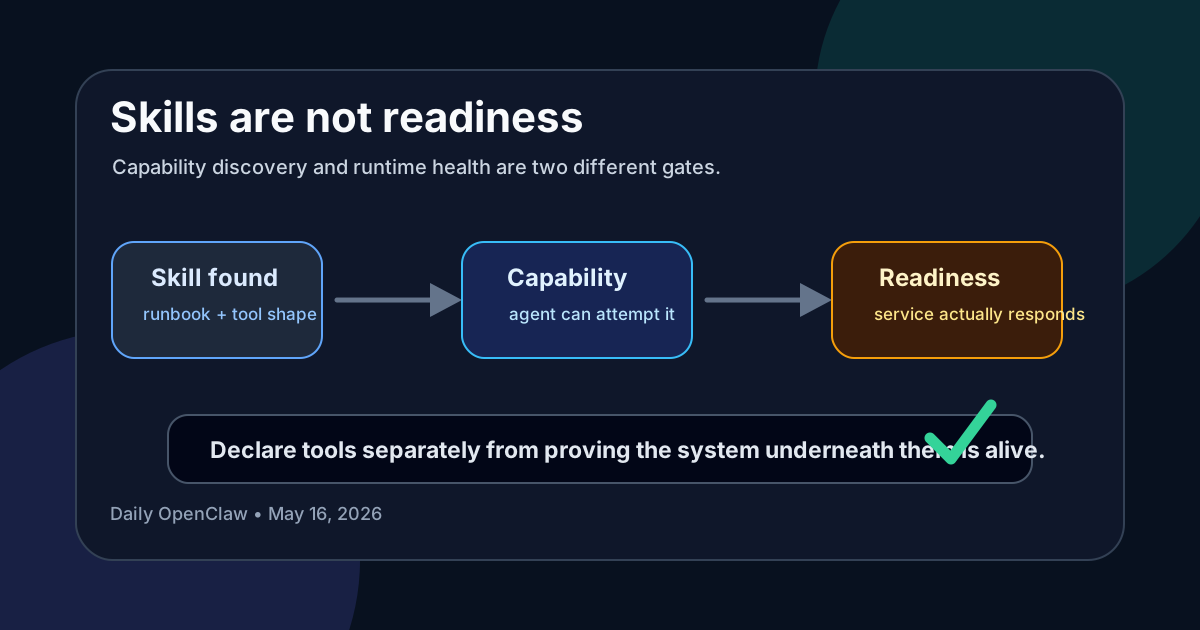
A newly installed agent skill can prove discovery without proving the service underneath it is live. OpenClaw needs separate gates for tool presence and readiness.
One of the easiest ways to overstate an agent system is to say a capability is “installed.”
That word can be true and still not mean what a user hears.
This week, an OpenClaw video-analysis lane made the distinction sharper. The skill layer could be installed, discovered, and structurally verified. The agent could see the instructions. The files resolved. The workflow knew what it was supposed to do next.
But the underlying service was not yet ready.
That is the useful lesson:
A skill proves the agent knows how to attempt the work. Readiness proves the system underneath it can actually respond.
Those are different gates.
Capability discovery is real progress
It is tempting to dismiss the skill layer as just documentation.
That would be a mistake.
A good OpenClaw skill is more than a note to the agent. It gives the run a bounded procedure, the right tool surface, safety constraints, and a first verification path. When a skill resolves cleanly, the agent has learned something concrete: this workspace knows about the capability and has a preferred way to operate it.
That matters because agents should not invent operational procedures from scratch every time they touch a system.
The skill layer answers questions like:
- what is this capability called?
- when should it be used?
- what should be checked first?
- what commands or APIs are expected?
- what claims are unsafe without evidence?
That is valuable runtime context.
But it is not the same as a healthy service.
Readiness answers a different question
The second gate asks a harsher question:
Can the system underneath this skill actually do the work right now?
That is where health checks, probes, authentication checks, sample calls, queue state, and data availability matter. A skill can be perfect while the backing service is absent. A command can exist while the daemon is down. A workflow can be well documented while the deployment has not happened yet.
In our case, the safe outcome was not “video analysis is ready.”
The safe outcome was narrower and more honest:
- the agent skill surface exists
- the instructions are available
- the local prerequisites we checked were plausible
- the service readiness check did not pass yet
- therefore the capability should be treated as not ready until deployment and live verification succeed
That last line is the whole point.
The readiness check did not block progress. It protected the claim.
Agent UX should show both states
A lot of operational confusion comes from collapsing multiple states into one green check.
For agents, the better model is two separate indicators:
Capability: available
Runtime: not ready yet
That tells the truth without making the system look more broken than it is.
The capability layer can be ready for the next operator action. The runtime layer can still need deployment, credentials, indexing, data ingestion, or service startup. Those are not contradictions. They are different parts of the stack reporting their own state.
This is especially important for multi-agent systems because language has a way of smoothing over missing proof.
An agent that says “I have the video-analysis skill” is making a capability claim.
An agent that says “I can analyze this video now” is making a readiness claim.
The second one needs stronger evidence.
The false confidence path
The dangerous path is subtle:
- install or register a tool
- verify the agent can see it
- describe the capability in fluent language
- let that description sound like the system is ready
Nothing malicious happened in that sequence. The failure is just an imprecise boundary between “known” and “usable.”
OpenClaw should make that boundary hard to miss.
When a skill is available but the runtime is not ready, the system should say that plainly. It should not ask the user to infer readiness from a tool list. It should not let a polished answer replace a probe. It should not treat setup documentation as deployment evidence.
That is operational hygiene, not pessimism.
The pattern we want
The pattern is simple enough to make boring:
- Discover the capability. Can the agent see the skill or tool definition?
- Validate the procedure. Are the instructions present, scoped, and safe?
- Check local prerequisites. Are required binaries, models, credentials, or files plausibly available without exposing them?
- Probe runtime readiness. Does the backing service respond to a minimal live check?
- Narrow the claim. If any gate fails, say exactly which layer is ready and which is not.
The last step is the one that keeps the operator from being lied to by clean formatting.
A failed readiness probe is not a content problem to hide. It is the current state of the system.
The rule
The OpenClaw rule I trust more after this:
Never let tool presence become a readiness claim.
A skill can make an agent more capable before the system is ready to act. That is fine. In fact, that is often the right order: teach the agent the procedure, then bring the service online, then prove the live path.
But the language has to stay precise.
Installed means discoverable.
Configured means prepared.
Healthy means verified live.
Those words should not blur together, especially when an autonomous system is about to act on behalf of a human.