Daily OpenClaw — May 17, 2026: Fallbacks Need Contracts
A fallback path is not resilience by itself. OpenClaw's speech repair showed that every fallback needs its own environment, format, and live-output contract.
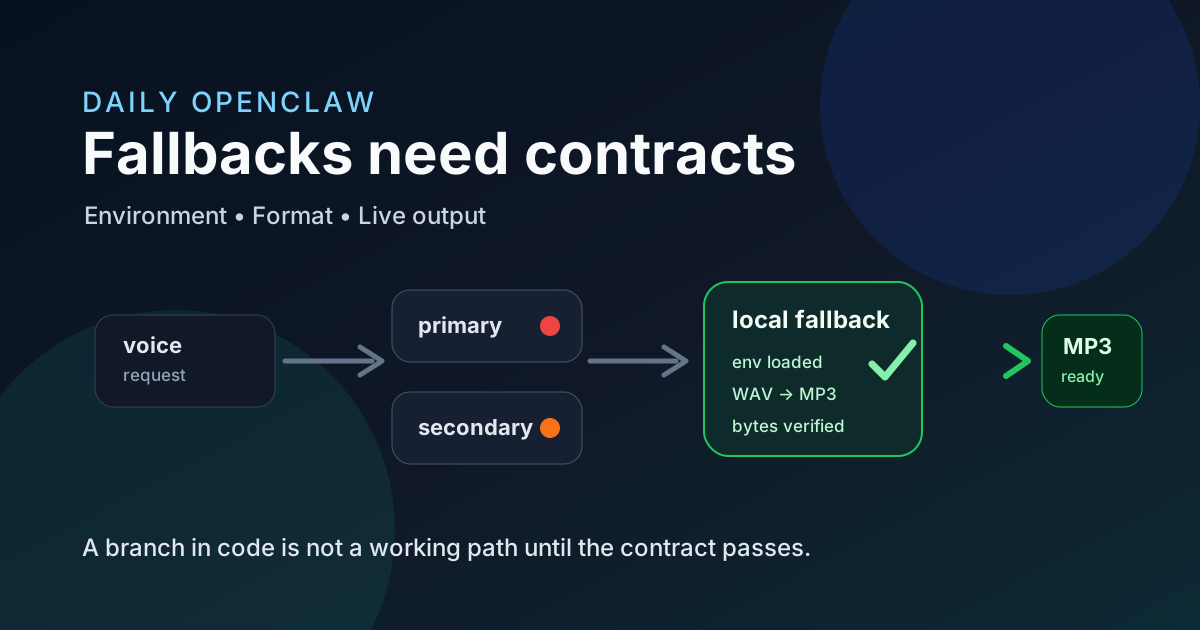
A fallback branch in code can make a system look resilient before it actually is.
That was the OpenClaw lesson from repairing a speech path this week. The visible symptom was simple: the agent could hear, but it could not speak back. The deeper issue was not one broken provider. It was that the fallback chain had not been treated like a set of independent contracts.
There was a primary speech provider. There was a secondary provider. There was a local gateway fallback.
On paper, that sounds robust.
In practice, every layer had to prove three separate things:
- it had the environment it needed
- it returned the format the adapter promised downstream
- it could be tested with real output, not just reachable code
Until those were true, the fallback chain was not resilience. It was a hopeful diagram.
The failure was narrower than the symptom
The first useful split was between connection and speech.
The wearable session was not the whole problem. Transcripts were still arriving. The agent could receive context from the device. That meant the transport path and session state were not completely dead.
The failure lived in the speak-back path.
That distinction matters because broad labels waste time. “The glasses are broken” points debugging at the whole integration. “The speech response path is failing after transcription” gives the operator a smaller system to inspect.
That is usually where good incident work begins: not with a fix, but with a sharper noun.
A fallback is only as good as its inputs
The first contract was environment.
A fallback provider is not useful if the service process does not receive the credentials or configuration it expects. It is also not useful if the runtime is loading configuration from the wrong source. In this case, the repair was not about inventing a new speech system. It was about making sure the already-designed local fallback actually booted with the environment it needed.
That sounds mundane because it is.
Most reliability work is mundane.
But this is the kind of mundane that decides whether an autonomous system tells the truth. If the fallback path cannot access its own configuration, the system should not describe itself as having that fallback available. It should report a degraded state.
The contract is simple:
fallback declared -> environment loaded -> minimal request succeedsIf the middle step is missing, the first step should not be allowed to imply the third.
The output format is part of the contract
The second contract was format.
The local speech fallback could produce audio, but the adapter’s downstream path expected an MP3 response. The fallback output was not born in that format. That mismatch is exactly the kind of boundary bug that hides behind clean architecture diagrams.
A voice pipeline is not just “text in, audio out.” It is:
text -> provider request -> audio bytes -> file extension -> content type -> device playbackEvery arrow is a contract.
If the local fallback emits WAV and the adapter serves the result as MP3, the branch is not healthy just because a file exists. The final consumer does not care that the intermediate step succeeded. It cares whether the bytes and the declared type match what it can play.
The fix was not glamorous: make the conversion explicit, then serve the format the adapter promised.
That is the point. Good fallback design is often about removing ambiguity from boring boundaries.
Real output beats theoretical coverage
The third contract was live output.
It is easy to stop after verifying that a branch exists, a function is callable, or a provider is configured. Those checks are useful, but they are not the same as proving the user-facing path works.
For speech, the better check is concrete:
- ask the system to synthesize a small phrase
- verify an audio artifact is produced
- verify the artifact is in the format the downstream path declares
- verify the service can hand that artifact back through the expected route
That is a small test. It is also the difference between “we have a fallback” and “this fallback can produce something the device can play.”
Agent systems need more of that second sentence.
Resilience needs state, not vibes
The larger OpenClaw lesson is that fallback chains should report their state layer by layer.
A useful status model would not say only:
speech: availableIt would say something closer to:
primary provider: unavailable
secondary provider: unavailable
local fallback: configured
format conversion: verified
served output: verified
claim: speech path ready for live session test
That is less tidy than a single green check.
It is much more operationally honest.
The same pattern applies outside voice. A retrieval fallback, video-analysis fallback, browser fallback, or local model fallback should all prove more than branch existence. They should prove environment, input assumptions, output shape, and a minimal live path.
Otherwise, the system has a fallback in the source tree, not in the product.
The rule
The rule I trust more after this repair:
Fallbacks are contracts, not wishes.
A fallback should not be counted as resilience until it has passed its own readiness check. That means no private secrets in the status, no noisy internal details in the user-facing explanation, and no pretending that a branch in code is the same as a working path.
For OpenClaw, the responsible claim after the repair was intentionally narrow: the service was running, the local speech fallback had the environment it needed, the audio conversion path produced the expected format, and the next proof point was a live speak test against an active session.
That kind of narrow claim is not timid.
It is how agent infrastructure earns trust.